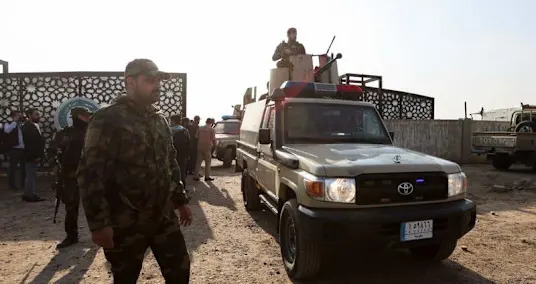
The militia forces could bolster the Islamic Revolutionary Guard Corps in Iran. They could also be used by Iran to enforce order and carry out suppression in some areas on its periphery.
In the wake of the February 28 US and Israeli attacks on Iran, there has been an attempt by Tehran to widen the war throughout the region. One of the countries that has become a key frontline is Iraq. There, the Iranians back a group of Shi’ite militias that are called Hashd al-Sha’abi. These militias are also linked to the Iraqi state. Many of the militias are viewed as terrorist groups by the US.
Since the war began, there have been more than 700 attacks by the militias across Iraq. They have targeted the US Embassy and US personnel in Baghdad, they have kidnapped a US journalist, Shelly Kittelson, and they have concentrated their attacks on the Kurdistan Region of Iraq. There are also increasing concerns that the militias may send forces to Iran.
The militia forces could bolster the Islamic Revolutionary Guard Corps in Iran. They could also be used by Iran to enforce order and carry out suppression in some areas on its periphery. For instance, it is believed that elements of the Hashd could be deployed in the Kurdistan regions of western Iran.
Many of the militia groups have direct ties to Iran's IRGC
Why would militias be able to operate effectively in Iran? The videos, which are alleged to show the Iraqis crossing to Iran, have shown convoys of vehicles, mostly pick-up trucks, heading to Iran. The trucks are adorned with flags, and they carry items in the back. These are mostly types of trucks that are hard to distinguish from civilian pick-up trucks. How would aircraft monitoring the situation know whether these are civilians or members of militias? This is where the Hashd has always excelled. They are both a militia and a paramilitary group drawn from Shi’ite groups in Iraq.
The Hashd are also officially part of Iraq's security forces under the umbrella of the Popular Mobilization Forces. The PMF has dozens of brigades, each of which is part of a militia. For instance, many brigades are staffed by members of groups such as Badr, Asaib Ahl al-Haq, Kataib Hezbollah, and Harakat Hezbollah al-Nujaba. This is how the Iraqi militias operate on both sides of the line of legality; both as official forces and as militias.
Many of the militia groups have direct ties to the Iranian IRGC. For instance, Kataib Hezbollah is considered directly tied to the top levels of the Iranian IRGC. Abu Mahdi al-Muhanids, the late leader of Kataib Hezbollah, served with the IRGC in the 1980s and was involved in bombing embassies in Kuwait. He was killed in 2000 alongside IRGC Quds Force head Qasem Soleimani in a US airstrike in Baghdad. This shows how these groups have worked for the IRGC since the 1980s. Badr, another large militia led by Hadi al-Amiri, has also been working with the IRGC since the 1980s during the Iran-Iraq war.

Not much is known regarding how many Iraqi militias may have crossed to Iran, or where they have gone. Most of what exists are rumors. It’s not the first time that Iraqi militias are alleged to have been moved to Iran to assist the regime. The regime in Iran is alleged to have invited them to help put down protests in the past.
The militia movement to back Iran is part of the larger war effort of the groups in Iraq. Iraq still has not chosen a new prime minister since the elections in November 2025. As such, the country is in a kind of chaos, and the militias are exploiting this. In Iraq, there have been large protests by backers of Shi’ite cleric Muqtada al-Sadr against the US and Israeli attacks on Iran. “Iraq’s prominent Shiite cleric and politician Ammar al-Hakim on Saturday called for continuing Iraq’s government formation despite the ongoing regional war, urging political blocs to fulfill constitutional obligations without postponement,” Rudaw media has reported in Erbil.
Iran International reported a week ago that “viewers who contacted Iran International said the arrival of Hashd al-Shaabi fighters in Abadan [Iran] had made the city feel ‘unsafe and frightening,’ and said residents were worried about their children.” Meanwhile, in Iraq, Hadi al-Amiri is rumored to be in talks with the Shi’ite Coordination Framework, a bloc of parties, to enter into a temporary truce with the US. In another development, Iran has said it will allow Iraq to export oil through the Strait of Hormuz. This will benefit Iraq, whose exports declined in March to near zero. It’s possible that Iraq could offer some of the Hashd as support for Iran in exchange for this oil deal.
In addition, an airstrike on a border crossing from Iraq to Iran may be linked to the movement of militias. Reuters reported on April 4 that “passenger movement has returned to normal at the Shalamcheh border crossing between Iraq and Iran after it was closed following air strikes on the Iranian side that killed an Iraqi citizen, security sources and state news agency said on Saturday.”
LATEST POSTS
- 1
 Step by step instructions to Explore the Close to home Consequence of Cellular breakdown in the lungs
 - 2Hamas Navy head, engineer of Khan Yunis tunnel network killed in Gaza, IDF confirms
- 3Qatar, Ireland accuse Israel of using chemical weapons on Palestinians, demand watchdog probe use
- 4Firefighters rescue two Israelis trapped in vehicles on flooded roads in West Bank
- 5The Force of Organic product: 10 Assortments That Improve Your Wellbeing


- I’m a neuroscientist who taught rats to drive − their joy suggests how anticipating fun can enrich human life
- The Main 15 Powerful Business Heads of Today
- 'Pluribus' release date: Everything you need to know about the new series from 'Better Call Saul's' co-creator
- 6 Hints to Upgrade Your Charm, In addition to Your Mentality
- From Iran to Israel: An Iranian volunteer’s unlikely stand in wartime
- Australians told to continue Easter travel plans despite fuel shortages
- The Main 20 Gaming Control center Ever
- Doulas play essential roles in reproductive health care – and more states are beginning to recognize it
- Most loved Well known Accessory Styles For 2024