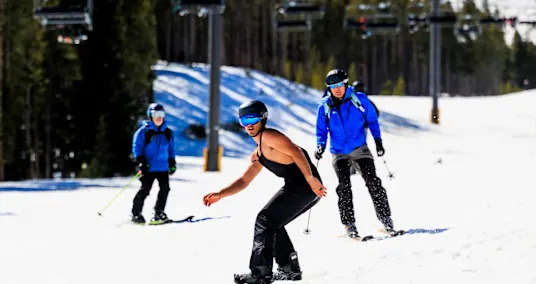
The scorching spring heat dome that baked the West for well over a week has finally moved along, after setting more than 1,500 temperature records across 11 states, according to the research group Climate Central.
In its wake, climate scientists, irrigation managers and local officials are taking stock of a looming water crisis and trying to make sense of just how exceptional the heat wave turned out to be. Even before the high temperatures arrived, Western states were reporting some of their weakest snowpack numbers in modern history. Now, in many places, little snow remains.
Researchers have long recognized that climate change intensifies heat waves. But some scientists are wondering whether novel or little-understood climate dynamics could help explain the length, intensity and breadth of this month’s event.

Jennifer Brady, a senior data analyst at Climate Central, said the heat wave’s widespread footprint and duration made it an outlier “even with what we’re experiencing now with climate change and what a lot of people refer to as our new normal, or our new baseline.”
The organization developed a metric it calls the “Climate Shift Index,” which rates the influence of climate change on average daily temperatures from 1 to 5.
About 29% of the country recorded maximum temperatures that Climate Central classified as a “5” — meaning they were at least five times as likely because of climate change. Based on data dating back to 1970, it was the highest-ever share of the U.S. landscape that experienced such temperature anomalies, the group found.
“This is unprecedented and can be very dangerous,” Brady said.

The World Weather Attribution group — a consortium of scientists that presents statistical analyses quantifying how much climate change influenced a particular event — has said the earliest portion of the March heat wave was so statistically unlikely that it would be considered “virtually impossible” without climate change. Temperatures were 20 to 30 degrees Fahrenheit above average in some locations during that time.
In a report published on March 20, the group found that heat waves in the West have increased in intensity by more than 7 degrees Fahrenheit because of climate change, and that this event was 800 times more likely than it would have been in a world without global warming.
Climate change is responsible for a shift in temperature distribution across different parts of the world. Land is warming faster than the ocean, and the Western U.S. is warming faster than other regions, said Karen McKinnon, an associate professor in the department of atmospheric and oceanic sciences at the University of California, Los Angeles.
So although the average global temperature last year was about 1.47 degrees Celsius (2.65 degrees Fahrenheit) higher than in 1850-1900, “depending on where you are… we can already be getting to, you know, 4 or 5 degrees Fahrenheit warming,” McKinnon said.

But she added that scientists are increasingly interested in whether other factors beyond that baseline warming are contributing to severe heat waves like this. Some are investigating whether climate change is also causing shifts in atmospheric dynamics.
This month’s heat wave was the result of what’s known as a heat dome — a pattern in which a high-pressure system with clear, sunny weather parks over an area, trapping air like a stovetop lid and amplifying warming.
Some scientists think that climate change is causing broad-scale changes to atmospheric circulation patterns that cause heat domes, such as the movement of the jet stream. The polar jet stream is a ribbon of air that encircles the Northern Hemisphere at high altitudes and determines atmospheric pressure patterns. It often serves as a barrier between cold Arctic air and warmer southern air.
Some researchers have theorized that climate change has made the jet stream more wavy. The idea suggests that the jet stream is dipping lower and rising higher in latitude than it did in the past, causing dramatic swings in the continental U.S.
McKinnon said climate scientists are making progress on investigations into these questions but don’t yet have satisfying answers. Many scientists have competing theories, she added, and it could take several years to settle on a consensus.
“That’s basically the million-dollar question,” McKinnon said. “Are these circulation patterns made more likely due to climate change?”
This article was originally published on NBCNews.com



 Schools to start reopening after Nigeria mass abduction
- Thousands of Walgreens nasal spray bottles recalled. See which ones.
- Relive NASA's historic Artemis 2 launch to the moon in these stunning photos
- Best Amusement Park in Asia: Which One Is a Must-Visit
- Mickey Lee of 'Big Brother' fame dead at 35 after flu complications, family says
- Pick Your Favored kind of books
- The Best Computer games for Multiplayer Fun
- 35 million tons of food go to waste yearly in the US. Experts share tips to help stop it
- New Year's superstitions: Eating 12 grapes, avoiding laundry and other rituals that are said to bring good fortune