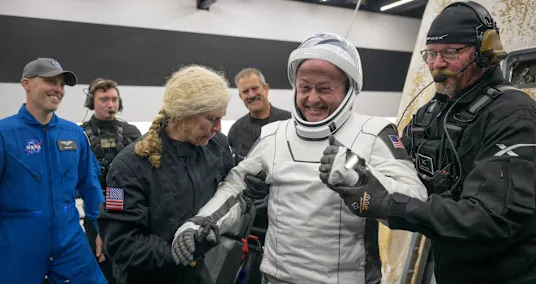
CAPE CANAVERAL, Fla. (AP) — The astronaut who prompted NASA’s first medical evacuation earlier this year said Friday that doctors still don’t know why he suddenly fell sick at the International Space Station.
Four-time space flier Mike Fincke said he was eating dinner on Jan. 7 after prepping for a spacewalk the next day when it happened. He couldn’t talk and remembers no pain, but his anxious crewmates jumped into action after seeing him in distress and requested help from flight surgeons on the ground.
“It was completely out of the blue. It was just amazingly quick," he said in an interview with The Associated Press from Houston's Johnson Space Center.
Fincke, 59, a retired Air Force colonel, said the episode lasted roughly 20 minutes and he felt fine afterward. He said he still does. He never experienced anything like that before or since.
Doctors have ruled out a heart attack and Fincke said he wasn't choking, but everything else is still on the table and could be related to his 549 days of weightlessness. He was 5 ½ months into his latest space station stay when the problem struck like “a very, very fast lightning bolt.”
“My crewmates definitely saw that I was in distress,” he said, with all six gathering around him. “It was all hands on deck within just a matter of seconds.”
Fincke said he can’t provide any more details about his medical episode. The space agency wants to make sure that other astronauts do not feel that their medical privacy will be compromised if something happens to them, he said.
The space station's ultrasound machine came in handy when the event occurred, he said, and he's gone through numerous tests since returning to Earth. NASA is poring through other astronauts' medical records to see if any related instances that might have occurred in space, he said.
Fincke identified himself late last month as the one who was sick to end the swirling public speculation.
He still feels bad that his illness caused the spacewalk to be canceled — it would have been his 10th spacewalk but first for crewmate Zena Cardman — and resulted in an early return for her and their two other crewmates. SpaceX brought them back on Jan. 15, more than a month early, and they went straight to the hospital.
“I’ve been very lucky to be super healthy. So this was very surprising for everyone,” he said.
Fincke stopped apologizing to everybody after NASA's new administrator Jared Isaacman ordered him to stop.
“This wasn’t you. This was space, right?" his colleagues assured him. “You didn’t let anybody down.”
Ever the optimist, he's holding out hope that he can return to space one day.
___
The Associated Press Health and Science Department receives support from the Howard Hughes Medical Institute’s Department of Science Education and the Robert Wood Johnson Foundation. The AP is solely responsible for all content.
LATEST POSTS
- 1
 US FDA grants market authorization to six on! PLUS nicotine pouch products
- 2Significant Elements to Consider Prior to Applying for a Mastercard: 6 Vital Contemplations
- 3Kids get diseases like lupus, too. As researchers hunt better treatments, this camp brings joy
- 4Disability rights activist and author Alice Wong dies at 51
- 5Finding the Universe of Workmanship: Individual Encounters in Imagination


- Meet ‘NASA Mike,’ who’s done 105,000 handstands around the world
- Architect Frank Gehry has died: See his most iconic buildings
- NASA says Maven spacecraft that was orbiting Mars has gone silent
- Moon rocket and weather are on NASA's side for the first astronaut launch in decades
- Grasping the Course of Evacuation and Extradition in U.S. Migration
- Raw oysters linked to ongoing salmonella outbreak infecting 64 across 22 states: CDC
- Hundreds are quarantined in South Carolina as measles spreads in 2 US outbreaks
- Different Film Classification: What's Your Go-To for Amusement
- It's your last chance to subscribe to Paramount+ before they raise their prices: Here's how to lock in current pricing