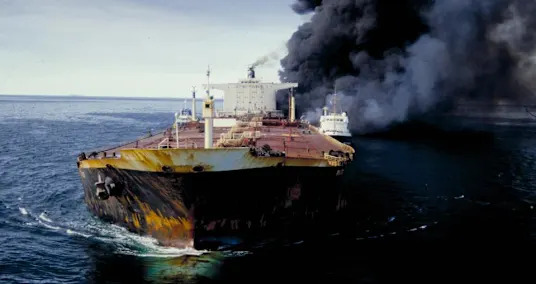

UNSPECIFIED - CIRCA 1987: "Pivot" tanker in flames during the Iran-Iraq war. The Ormuz straits, in December, 1987. FDM-1801-2. (Photo by Francoise De Mulder/Roger Viollet via Getty Images)
Roger Viollet via Getty ImagesThe war in Iran is affecting Iraq just as much as any other country. Iraq, which holds the fifth-largest proven oil reserves in the world, cannot reliably feed itself, power its homes, or, at this moment, fully pay its government workers.
The war may have brought its problems to a head, but its issues have been decades in the making—a function of wars dating back to the 1980s, financial mismanagement, and an over-dependence on its neighbors. The current disruption in the Strait of Hormuz has cut into Iraq’s oil export revenues. But beneath that immediate crisis lies an older and self-inflicted problem—one visible in the sky above its southern oil fields.
Iraq is on fire. Literally—by flaring natural gas.
I’ve been a recurring guest host on Cross Lines, a program on Al-Ahad TV that examines the country’s economy, alongside Bayraq Faisal Ghazion. Engineer Ali Jabbar, one of Iraq’s most respected crisis management experts, has openly made those arguments, emphasizing that the country is at a crossroads.
“We are losing between $6 billion to $8 billion a year just importing gas to support power plants. This is shameful for Iraq’s energy sector management,” Jabbar says.
Every day, over 1,400 gas flares burn in Iraq’s southern oil fields, releasing vast amounts of natural gas into the atmosphere—a byproduct of extracting crude oil. Iraq produces about 3.1 billion cubic feet of this gas each day. Nearly a third, around 1 billion cubic feet, is simply burned off and wasted.
The World Bank’s 2025 Global Gas Flaring Tracker ranks Iraq among the three worst offenders worldwide, behind Russia and Iran. That wasted gas, if captured and used, could go a long way toward powering Iraq’s own electric grid. Instead, Iraq imports gas from Iran.
Now the intrigue. From September 1980 to August 1988, Iraq and Iran fought one of the most brutal wars of the 20th century. Estimates of total casualties—soldiers and civilians combined—range from one million to two million people. The two countries fought over a river, over borders, and Persian Gulf dominance. Neither side won. And today, Iraq pays Iran somewhere between $4 billion and $8 billion a year to import the gas it needs to keep its power plants running—gas that Iraq is simultaneously burning off at the wellhead.
A Problem Hiding In Plain Sight

ERBIL, IRAQ - MARCH 17: Iraq, a member of OPEC, has had to sharply reduce oil production as its main export route, through the Strait of Hormuz, (Photo by Sedat Suna/Getty Images)
Getty ImagesHow much of Iraq’s electricity depends on that Iranian supply? Iraq’s own Ministry of Electricity has said that if Iranian gas imports were cut off, the country would lose more than 30% of its power. Others put it close to 40%. In a country where summer temperatures routinely exceed 120 degrees Fahrenheit, and families already rely on private diesel generators to survive the daily blackouts, that number is not academic.
LATEST POSTS
- 1
 The Best 20 Photography Instagram Records to Follow
- 2Brazil passes anti-gang law allowing seized crypto to fund security forces
- 3The Artemis II launch is tonight. Here's how to watch it live.
- 4Hostages as leverage: Iran's secret demand aimed at crippling Israel's agriculture
- 5From White Elephant to Favorite Things parties, here are all the rules you need to know every kind of gift exchange





- CDC advisory panel delays vote on hepatitis B vaccines after unruly meeting
- Cyclone Narelle turns Australian skies blood red in ‘apocalyptic’ scenes
- The Electric Toyota Hilux Is Finally here, But It's Not Cheap
- Gov’t approves millions for border cities in North under Hezbollah fire
- The Best 15 Applications for Efficiency and Association
- Clocks to go forward one hour in Europe as summer time starts
- Find Serenity: 10 Stunning Setting up camp Areas
- Swap The Amalfi Coast For This Low-Cost Ligurian Seaside Town
- Find the Advantages of Positive Nurturing: Supporting Cheerful and Sound Kids