When you buy through links on our articles, Future and its syndication partners may earn a commission.

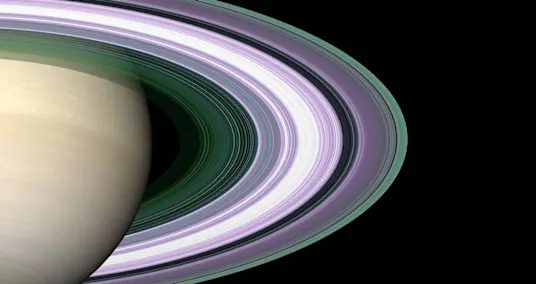
Saturn's iconic rings may be the shattered remains of a long-lost moon — and the same catastrophic event could also explain why the planet is tilted, according to new research.
Results presented at the Lunar and Planetary Science Conference in Texas which ran between March 10 and 14 suggest a hypothetical moon called Chrysalis may have ventured too close to Saturn roughly 100 million years ago, where powerful tidal forces stripped away the moon's icy outer layers. Some of that debris may have remained in orbit and eventually collided and spread out to form the complex ring system we see today.
The findings, led by Yifei Jiao of the University of California, Santa Cruz, are the latest in a growing body of evidence pointing to a solution to two long-standing puzzles, Saturn's present-day tilt and why its rings appear far younger than the planet itself, which formed more than 4.5 billion years ago.
"We don't know if there was a previous ring before this happens," Jiao told Space.com. But even if there wasn't, he said, the scenario can still produce an ice-rich ring system consistent with the mass of Saturn's current rings.
Additionally, it "can clearly explain why Saturn's rings are young," he said during his presentation.
The new work builds on similar findings of a 2022 study led by Jack Wisdom at the Massachusetts Institute of Technology, which proposed that Saturn once hosted an additional moon — Chrysalis — that played a crucial role in shaping the planet's tilt.
The gas giant is tilted by about 26.7 degrees, and scientists have long suspected this is linked to a gravitational resonance with Neptune — meaning the two planets were once in a kind of orbital rhythm, with Neptune's repeated gravitational tugs helping set Saturn's tilt. In that earlier work, scientists said Chrysalis orbited Saturn for billions of years, helping maintain that alignment.
But sometime between 100 million and 200 million years ago, the moon's orbit became unstable, and a series of gravitational interactions sent Chrysalis on a fatal, grazing encounter with Saturn. Most of the moon would have been destroyed or fell into the planet, but a small fraction of debris remained in orbit, resulting in the raw material for Saturn's rings, scientists suggest.
Using computer simulations to model the breakup in detail, Jiao's team found that Saturn's tidal forces would have preferentially stripped away the moon's icy mantle while leaving much of its rocky core intact. That distinction naturally explains why Saturn's rings are composed almost entirely of water ice, with very little rock, the study notes.
The stripped material was then shaped by gravitational interactions with large moons such as Titan, which could have removed as much as 70% of the initial ring mass over time. This suggests the original ring system may have been several times more massive than it is today.
Scientists are still investigating what ultimately happened to Chrysalis' surviving core, and whether debris from the event may have left traces elsewhere in Saturn's system — such as unusual impact features on icy moons that could perhaps be detected by future spacecraft.
LATEST POSTS
- 1
 Pick Your Favored kind of sandwich
- 2The 1st full moon of 2026 rises tonight! Here's what to expect from January's supermoon Wolf Moon
- 3This Unique National Park In Canada Is Famous For Its Otherworldly Limestone Monoliths
- 4A red meat allergy from tick bites is spreading – and the lone star tick isn’t the only alpha-gal carrier to worry about
- 510 Work Valuable chances to Assist with supporting Your Advanced degree



- Etymological Investigation Disclosed: A Survey of \Dominating New Tongues\ Language Learning Application
- Forget 'Outer Banks.' These Gen Z-ers just want to watch 'M*A*S*H*' and 'Gilmore Girls.'
- How to disinfect if the stomach bug hits your home
- ONE returns to Red Sea with new service
- Quandoo to shut restaurant booking platform by end of 2026
- Coca-Cola Co. and bottlers to invest in South Africa operations
- NASA astronauts take new moonsuit for a swim | Space photo of the day for Nov. 28, 2025
- Czech Republic's new premier: No money for Ukraine
- What will the Artemis 2 astronauts eat during their historic moon mission? (video)